OUR HISTORY

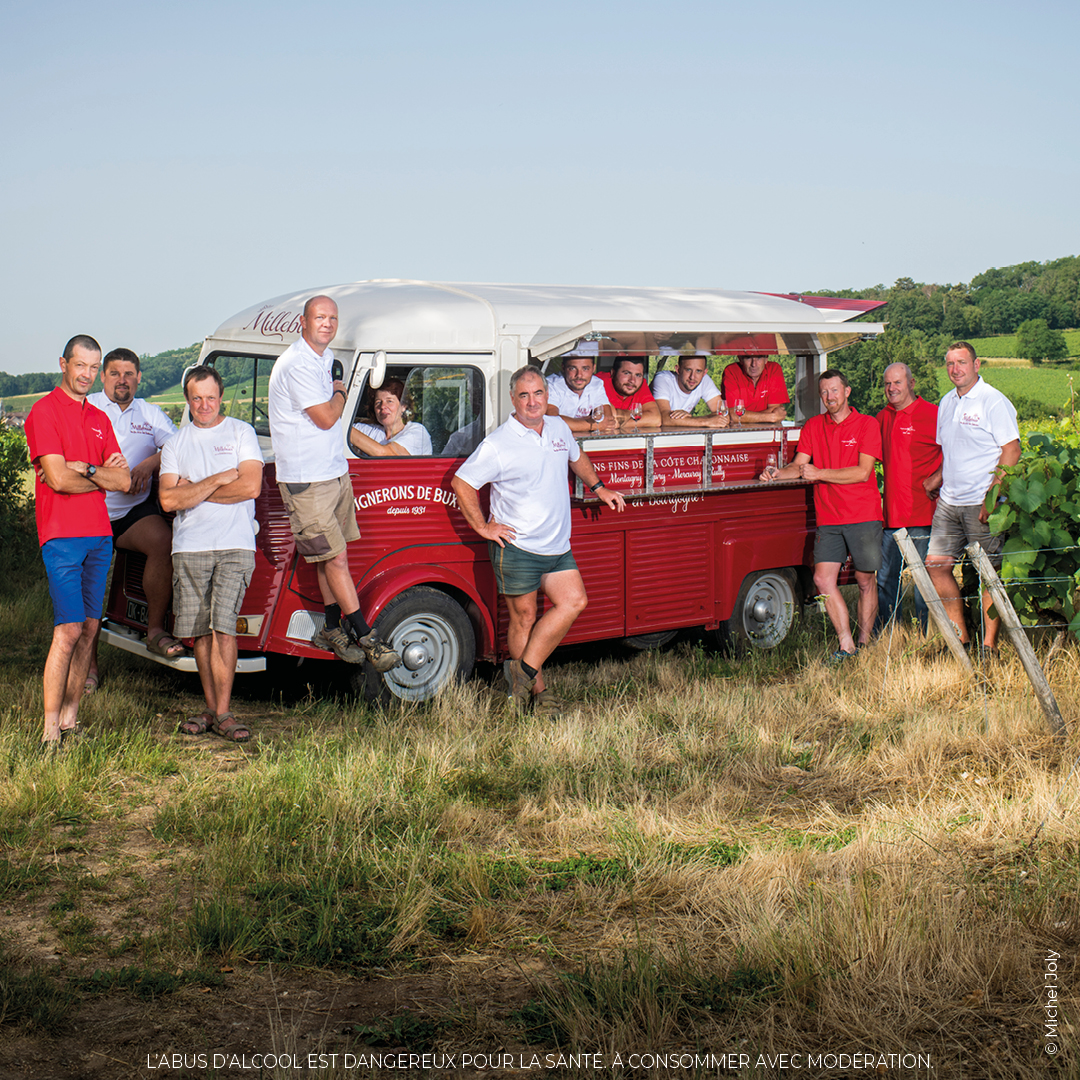
The Cellar of Vignerons de Buxy, The Millebuis company was born from the desire of winegrowers in the Côte Chalonnaise to unite around a common project: to vinify, age, and market their wines together. An epic journey that began a little over 80 years ago, in 1931, and has transformed into an exceptional human adventure…

Our winemakers cultivate this vineyard using techniques passed down through generations. Together, these men and women uphold values ​​that champion quality and respect for the environment. Through their hard work, their passion for their craft, and their deep connection to the land, these winemakers have revealed the unique character of their terroir.

The grouping of these small family farms (on average 15 hectares of vines per family) driven by the same values ​​of solidarity, sharing and conviviality has given rise to a very efficient production tool.

The culture of the vine and the harvest of the grapes require multiple skills. The objective is the creation of wines that reflect the excellence of the terroirs of the Côte Chalonnaise.

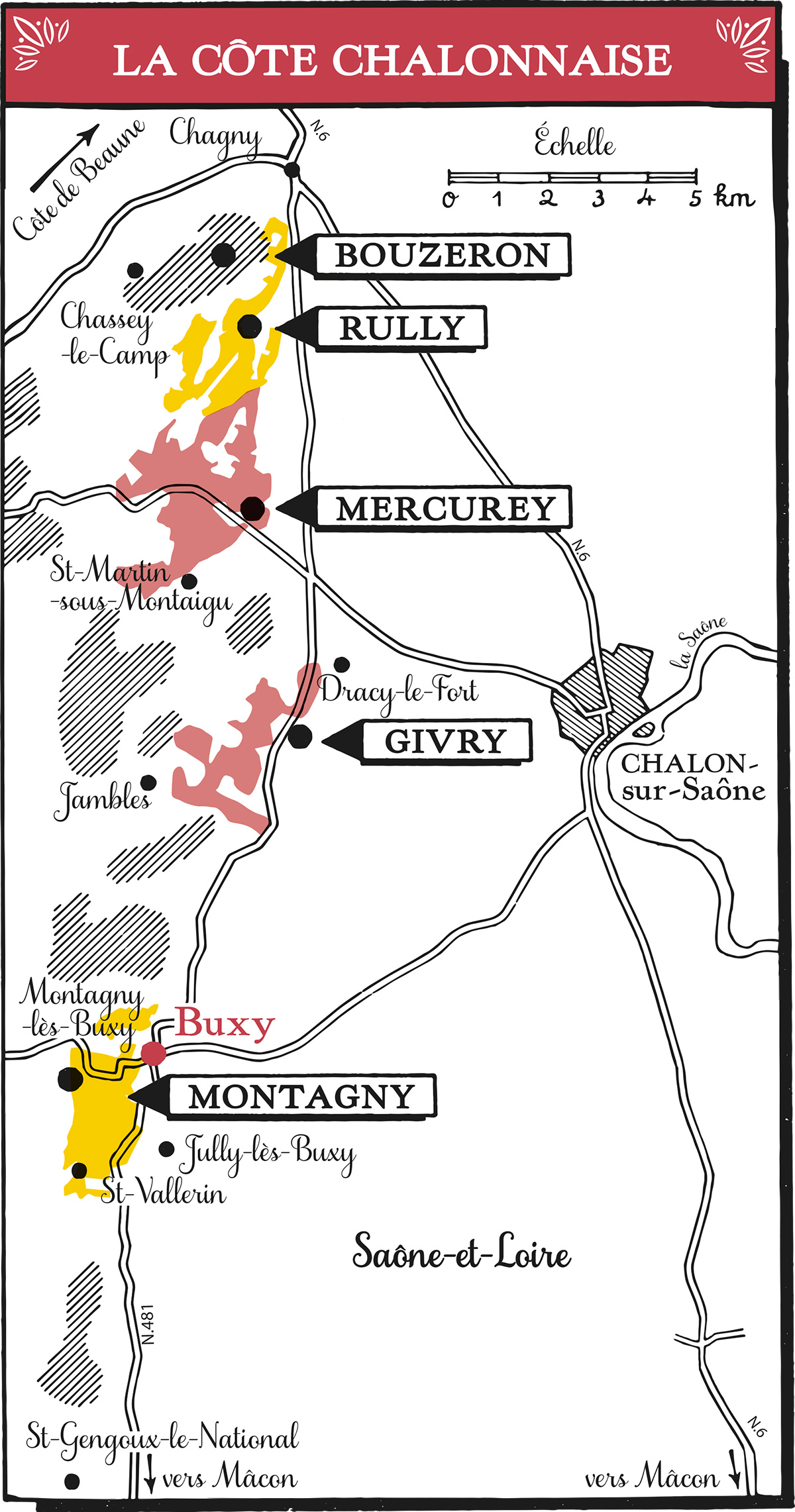
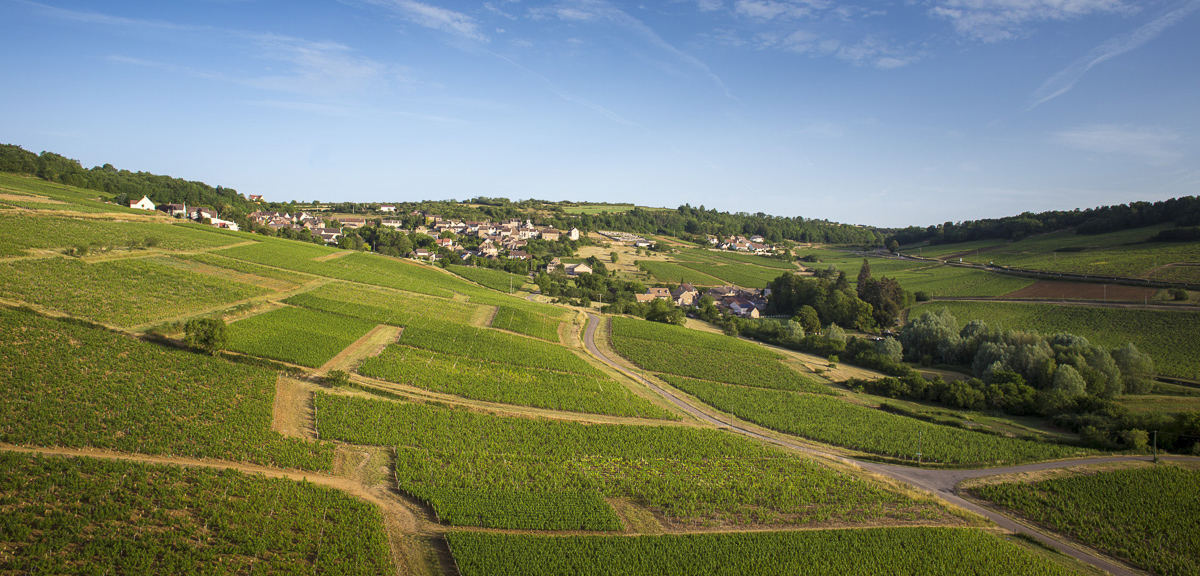
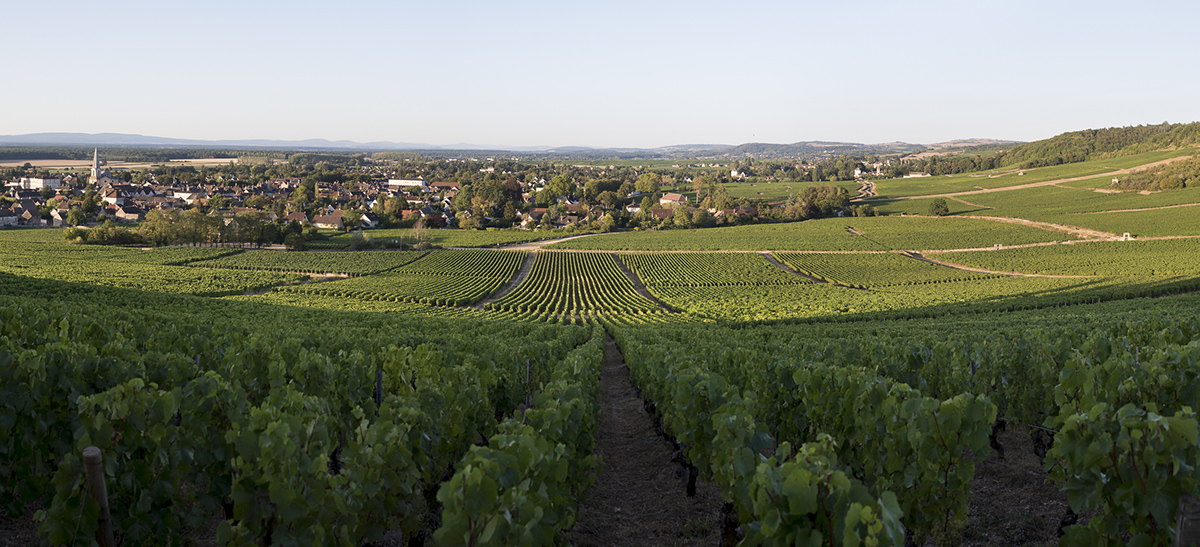
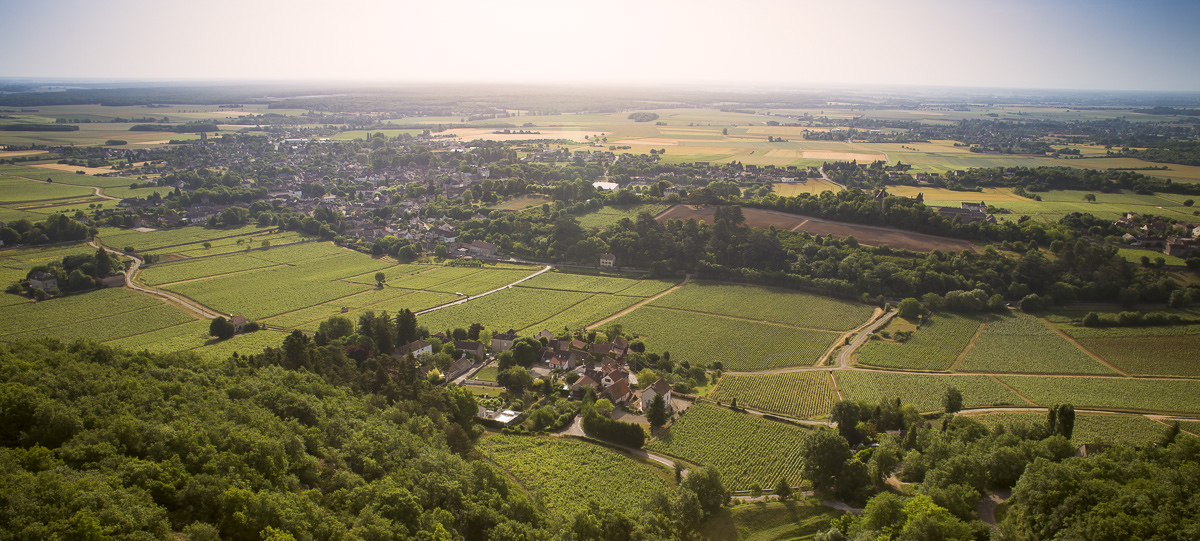
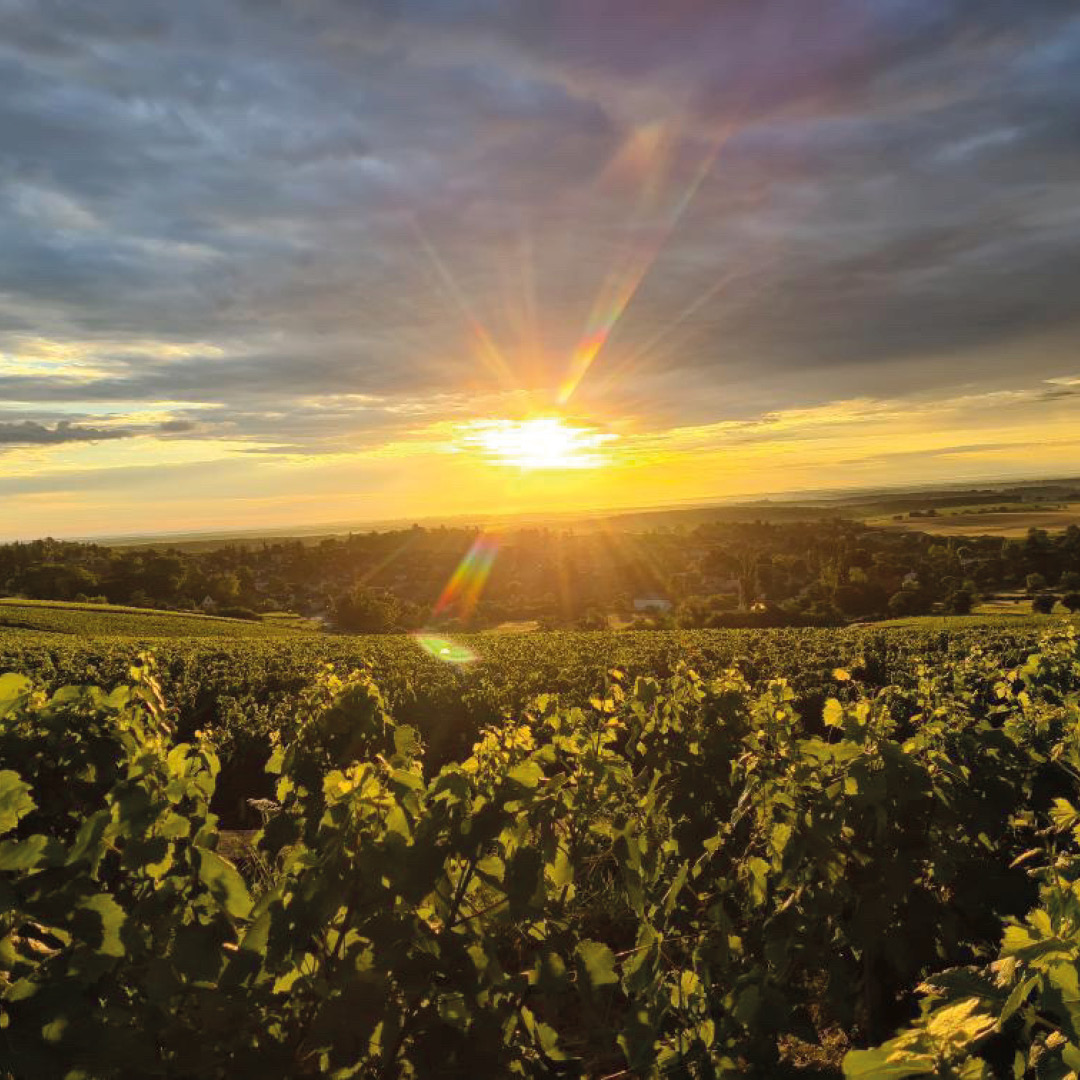
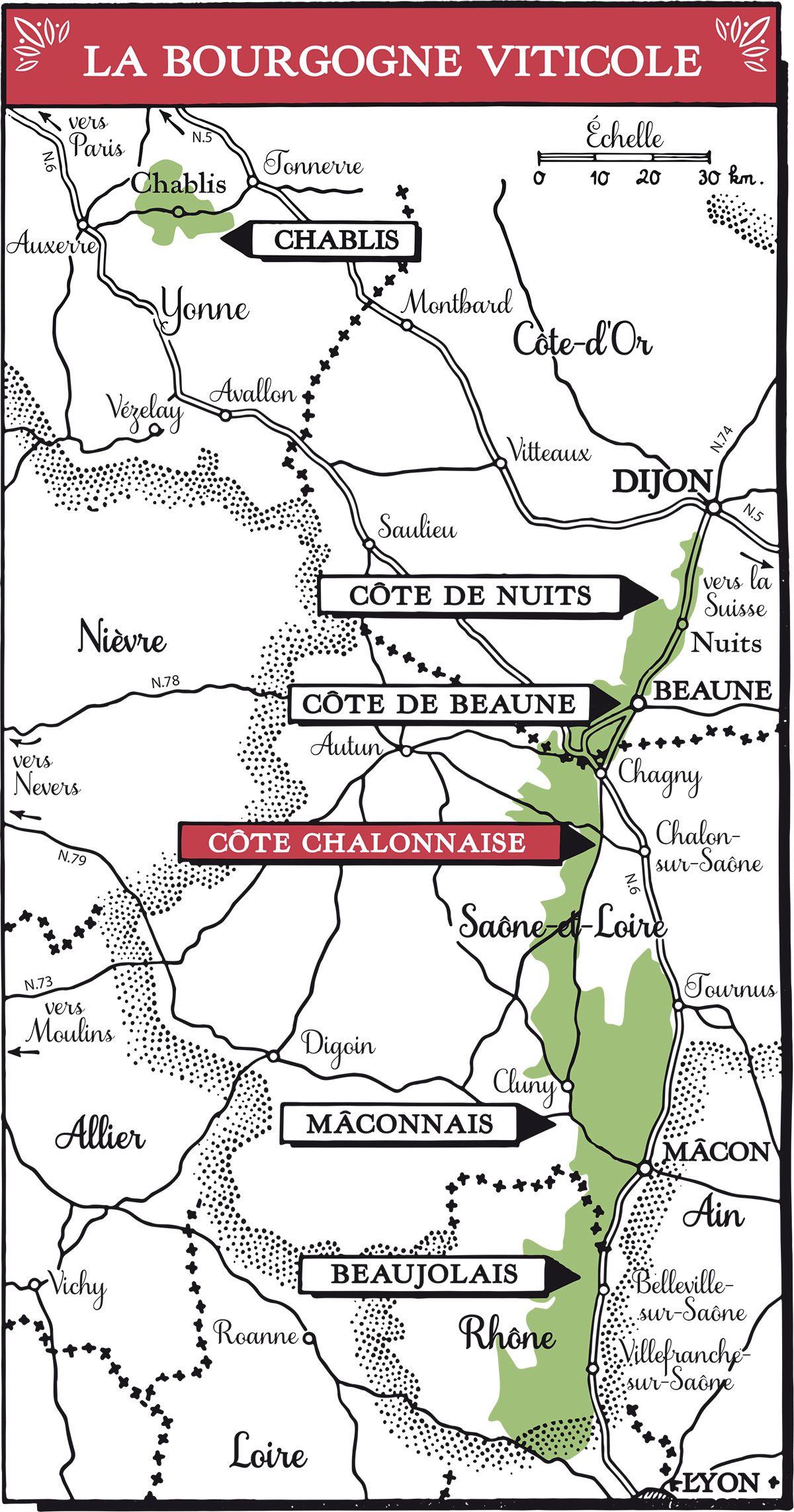
Along the Saône valley, south of the Dheune, from Chagny to Saint-Gengoux-le-National, the Côte Chalonnaise vineyard stretches from north to south, bending slightly towards the southwest in its southern part, over a length of about 30 kilometers and a width of about 7.

The Côte Chalonnaise vineyard, with its continued presence of Pinot Noir and Chardonnay, and its organization into small, distinct villages, follows in the footsteps of the two famous vineyards of the Côte de Nuits and the Côte de Beaune. Following in their footsteps and on the same level.

The 44 communes that comprise the appellation produce a red wine entitled to the general designation “Bourgogne Côte Chalonnaise” if it is made from the Pinot Noir grape variety under the yield, minimum alcohol content, and cultivation methods specified by the decree on Appellations d’Origine Contrôlée (AOCs). In addition, five communes have obtained an independent appellation decree for their name, to which they may occasionally add the name of a specific vineyard site, following the practice in the Côte de Beaune and Côte de Nuits; these are, from north to south: Rully, Bouzeron, Mercurey, Givry, and Montagny.

The same duality exists in the white wines: “Bourgogne Côte Chalonnaise” is harvested in the northernmost communes of the vineyard; to the north and south of this growing area, the Chardonnay grape variety, whose continuity throughout Burgundy provides the great wines, notably those of Meursault and Montrachet, still gives two remarkable wines: Rully and Montagny.

“Along the route opened by the winegrowers of the Côte d’Or, wines were transported to Paris, following the wines of Beaune, in the XIVth and XVth In the 16th century, the wines of the Chalon-sur-Saône region, then known as Chaulnois or Saulnois, were renowned. Those harvested in Givry and Germolles, on the hillside closest to this old episcopal city, were already highly regarded. Eustache Deschamps praised them. The Germolles vintage is also mentioned in the list of wines stored in Arras between 1386 and 1404 for the Duke of Burgundy.

At the southern edge of the area involved in this trade lay two vineyards of monastic origin, one belonging to the Cluniac priory of Saint-Jangou (now Saint-Gengoux-le-National), the other to the abbey town of Tournus. The name Saint-Jangou follows those of Beaune and Saint-Pourçain in the list of wines served at a wedding feast described in 1316 in the Roman de Fauvel. It reappears in the royal accounts of 1380 and 1389. Perhaps this success had been prepared, to some extent, by a paréage treaty of 1166 which linked the King of France to the Abbot of Cluny in the exercise of sovereign rights at Saint-Gengoux, and declared this town irrevocably attached to the person of the king himself, hence the name Saint-Gengoux-le-Royal, which, since the Revolution, has become Saint-Gengoux-le-National. Tournus, finally, produced, towards the end of the XIVth century, a Pinot wine that Eustache Deschamps praised as equal to the most famous, and which could easily be passed off as Beaune wine.
In this southern part of the Burgundy coast, the vineyard benefited from the reputation of that of Beaune, to which it was considered related. The royal edicts of 1349 and 1351, establishing a tax on goods sold in Paris, applied the highest tax levied on wines originating from the kingdom to the wines of Givry and Saint-Jangou, as well as those of Beaune. The name Tournus, in the XVth century, appears more than once, alongside those of Beaune or Saint-Jangou, in the declarations made at the Paris City Hall by the merchants who supply Artois or Flanders with quality wines.”

Roger Dion, History of vines and wine in France / from their origins to the XIXth century, 1959

“Between Chagny and Tournus, from the Saône to Saint-Gengoux-le-National, between the Grosne and Dheune valleys, the Côte Chalonnaise possesses a truly distinctive character. As soon as you cross the Dheune, the river that extends the Montceau-Le Creusot ditch, the hills fill the landscape, broadening its horizons. The Côte owes its name to Chalon-sur-Saône, a former town of fairs and markets that became an industrial city, a bustling port from which the region's wines were shipped. The tall chimneys of the Saint-Gobain factory are a reminder that many bottles of Burgundy originate from here. In addition to the Maison des Vins de la Côte Chalonnaise (Wine House of the Côte Chalonnaise), several festivals draw inspiration each year from medieval revelry: the carnival and the street arts festival. The Chalon vineyards entered history very early, but amidst a linguistic controversy. In his famous text on Dijon, in the VIth In the 11th century, Gregory of Tours mentions the wines of the Côte. He notes that the people of Dijon consider them equal to Falernian, a famous wine of Antiquity, and thus turn away from the wine of Chalon. We would get lost in arduous explanations to find that the Latin word for Chalon at that time (no doubt, Roger Dion has explained this) was Ascalon, another ancient wine. These geopolitical rivalries, more than mercantile in nature, simply reflect the competition between Chalon and Dijon, already mentioned by Gregory of Tours!

THE NORTH OF THE MASSIF CENTRAL

La Côte Chalonnaise appartient à la façade orientale du nord du Massif Central. À l’ère tertiaire, le fossé bressan s’est affaissé. Cette partie méridionale de la Côte bourguignonne a subi une dislocation: des compartiments faillés, à ossature calcaire, de l’âge jurassique.
Au nord, ils s’orientent au levant. Au-delà de la faille transversale de Bissey, les terrains calcaires jurassiques dominent (Rully, Mercurey, Givry), mais Saint-Denis, Jambles et Moroges voient affleurer des couches liasiques et même triasiques.

South of the Bissey granite outcrop, the slopes incline eastward or westward, facing the first hills of the Mâconnais region. A few outcrops of Triassic quartz sandstone meet the alluvial deposits of the Saône plain. The soils appear more marly, topped by the Bajocian limestone escarpment (Montagny). The foothills are covered with sands and flinty clays. “In short,” concludes geologist Noël Leneuf, president of the Burgundy AOC delimitation commission, “the Côte Chalonnaise presents a very clayey Triassic-Liassic sequence and a Middle and Upper Jurassic sequence where hard limestone and marl alternate, resulting in more gravelly and calcareous terroirs: rendzina soils, calcareous browns, sometimes deep and clayey.”

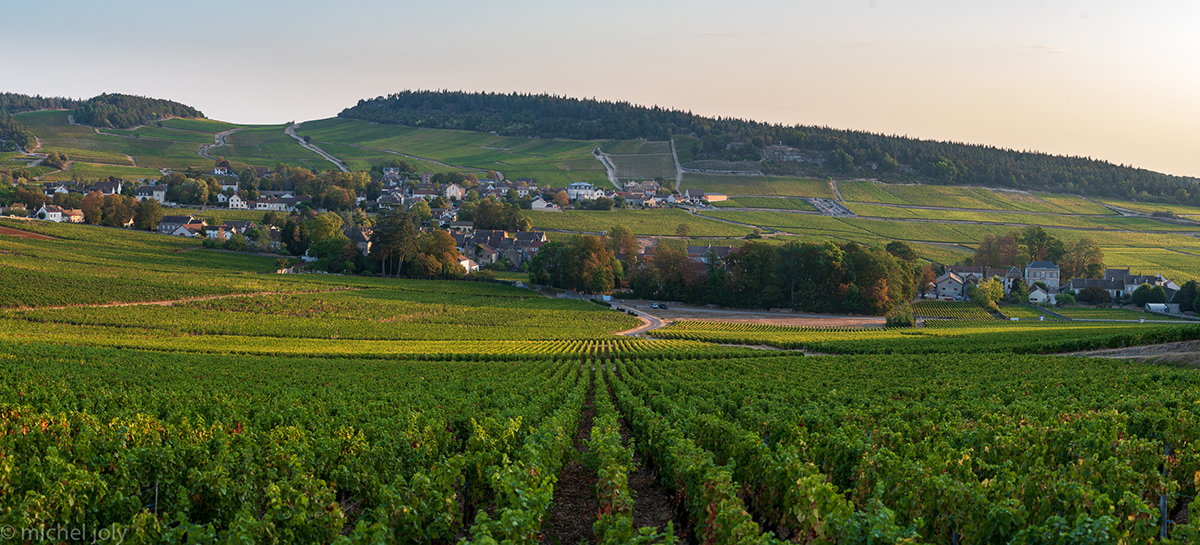
Some villages are perched high up: Culles-les-Roches, Saules, Moroges. Others are halfway up the slope: Chenôves, Montagny. Others are in the valley: Jambles, Saint-Vallerin, Saint-Boil.

A TERRAIN WHERE PINOT NOIR PARTICULARLY FLOURISHES

“The best white wines made from Chardonnay (Rully, Montagny) are produced on clay-limestone soils facing east, southeast, and south. The reds (Rully, Mercurey, Givry) come from Pinot Noir planted on limestone or less clayey calcareous soils. Granitic soils are suitable for Gamay Noir à Jus Blanc. On the lower slopes, the limestone is often covered with flinty silt, supporting leached brown soils, suitable for producing Gamay and Aligoté.”

The soils and climate are very similar to those of the Côte-d’Or. The cultivation and winemaking methods appear identical. As for its history, it is no less illustrious than elsewhere in Burgundy. However, the Côte Chalonnaise, isolated as it was, only managed to establish itself relatively late. For a long time, its wines were sold under the name Chablis for the whites, and under the names of villages in the Côte de Beaune for the reds. Producers from Champagne also came there to obtain base wine. In 1923, a ruling by the court of Chalon-sur-Saône defined the Côtes Chalonnaises appellation, but it did not catch on. Initially, the idea had been for an appellation called Côte de Mercurey or something similar. After a long battle waged in 1985, based on the designation most accurately reflecting the overall character of the vineyard, and led in particular by Paul de Launay and Aubert de Villaine, managing partner of Domaine de la Romanée-Conti and winemaker in Bouzeron, a decree in 1990 established the Bourgogne Côte Chalonnaise appellation. The words "Côte Chalonnaise" must appear on the label below "Bourgogne" and in a smaller font. The Hautes-Côtes de Nuits and de Beaune are not subject to these regulations.

The Côte Chalonnaise vineyard covers 4,475 hectares across village and regional appellations. The Bourgogne Côte Chalonnaise Appellation d’Origine (AOC) encompasses 44 villages. Its area extends over 3,665 hectares, but only 500 hectares were planted at the beginning of the 2010s, primarily with Pinot Noir and a small amount of Chardonnay. A thousand unplanted hectares benefit from prime growing conditions. These are the reasonable prospects for the expansion of this vineyard.

THE 44 COMMUNES OF THE CÔTE CHALONNAISE

Canton of Chagny

Aluze, Bouzeron, Chagny, Chamilly, Chassey-le-Camp, Dennevy, Fontaines, Remigny (partie sud), Rully, Saint-Gilles, Saint-Léger-sur-Dheune.

Canton of Givry

Barizey, Dracy-le-Fort, Givry, Jambles, Mellecey, Mercurey (y compris Bourgneuf-Val-d’Or), Rosey, Saint-Denis-de-Vaux, Saint-Désert, Saint-Jean-de-Vaux, Saint-Mard-de-Vaux, Saint-Martin-sous-Montaigu.

Canton of Buxy

Bissey-sous-Cruchaud, Bissy-sur-Fley, Buxy, Cersot, Chenôves, Culles-les-Roches, Fley, Jully-lès-Buxy, Montagny-lès-Buxy, Moroges, Saint-Boil, Saint-Martin-du-Tartre, Saint-Maurice-des-Champs, Saint-Vallerin, Santilly, Sassangy, Saules, Sercy.

Canton
of Mont-Saint-Vincent

Genouilly, Saint-Clément-sur-Guye, Vaux-en-Pré.

These municipalities all have plots of land delimited in 1989, giving the right to the Bourgogne Côte Chalonnaise appellation.

Since gamay thrives in the granite-tinged part of the terroir, the Bourgogne Passetougrain here is quite invigorating, rich and consistent.

In red, Bourgogne Côte Chalonnaise expresses finesse and suppleness under a bright, deep color, with appealing accents of small fruits.

Evoking flowers and dried fruit, the white wines are tender and vibrant and are best enjoyed a little younger than the reds.

Here, they also make great wines for aging…

ANDRÉ JULLIEN

Born in 1765 in Chalon-sur-Saône, André Jullien established himself as a wine merchant in Paris. There, he founded the wholesale wine business known as Pont de Fer (1, rue du Faubourg-Poissonnière), which later became Maison Rivet. He is credited with inventing several decanting devices. His *Manuel du sommelier* (Sommelier's Manual) dates from 1813 and was frequently reprinted. Then, starting in 1816, he published a substantial work, also continuously reprinted: *Topographie de tous les vignobles connus* (Topography of All Known Vineyards). He was the first author to catalog all the vineyards of Europe, Africa, Asia, and America. He notably discussed those of Chile, California, Hungary, Russia, and others. He died of cholera in 1832.

GERMOLLES, OR THE FAITHFUL HEART

Marguerite of Flanders, wife of Philip the Bold, brought him some of the richest lands in Europe and developed a passion for Burgundy. Her paradise was Germolles, an estate near Chalon-sur-Saône, acquired in 1381 and magnificently developed. Spanning 380 ouvrées (nearly 16 hectares), the walled vineyard of Germolles became the pride of the duchy: a model vineyard. This wine was offered to the ducal house's great allies: the Trémoille, Douay, and Rapondi families. The winemakers of Germolles invented the "English week" to allow them to work in their own vineyards on Saturdays and Sundays. Claus Sluter designed the décor of this inspired château, created in the style of the Très Riches Heures du Duc de Berry.

NICÉPHORE NIÉPCE

When Nicéphore Niepce thanked his Parisian collaborator Lemaître, he sent him, in the Burgundian style, a few bottles of sparkling white wine. Thus, this then-recent innovation from the Côte Chalonnaise became associated with one of the inventions that revolutionized modern times: photography, born between 1816 and 1826 in Saint-Loup-de-Varennes.

“We usually only see the true Côte bourguignonne in the narrow strip which, between Dijon and Chagny, spreads its vines in the sun; yet the limestone slopes which dominate the plains of the Saône extend well beyond, to the north and to the south.

South of Chagny, the Côte is indeed the direct continuation of the Côte de Beaune or de Nuits. Interrupted for a moment by the plain where the Dheune flows in, it resumes its character in the Chalonnais and the Mâconnais, all along the Saône and extends into the Beaujolais.

In truth, the limestone hillside is now merely a narrow strip between the older soils; the limestone disappears first near Buxy, then, at Mâcon, gives way to the crystalline slopes of Beaujolais. Only the Côte Chalonnaise still fully retains its Burgundian character; from Mâcon onward, in the southern extension of this slope, we are no longer truly in Burgundy; the influence of Lyon is too directly felt here; only the delimitation of Burgundy wines still links this region to Upper Burgundy; similarly, the Perche owes its reputation to its horses, and the Bassigny to its cattle, boundaries that are not always confirmed by other geographical features.

To the north, the edge of the Langres plateau lacks the sharpness of the Burgundy escarpment; the rift valley has eroded less deeply on the Saône side; the double escarpment of the Côte and the Montagne, observed near Beaune, is absent here. Yet the road from Dijon to Langres and the railway line from Dijon to Is-sur-Tille and Culmont-Chalindrey, which roughly follow the old Roman road, clearly mark the western edge of the plain, between 250 and 300 meters; some ten kilometers further west, we are on the plateau, at an altitude of over 500 meters (549 m at the Signal de Darois, 567 m at Saussy). Between the plain and the plateau lies a glacis that could be better compared to the Arrière-Côte (Hinterland Slope) than to the Côte (Slope), a Arrière-Côte that would connect directly with the plain.

As in the hinterland, dry valleys bear witness to the ancient activity of the waters, while further downstream, large springs gush forth the waters gathered deep within the limestone. Also as in the hinterland, larger rivers have carved out wide indentations, such as the Suzan valley and especially the Tille valley and its tributaries. The fields clustered around the narrow fortified hill of Saulx-le-Duc are reminiscent of the Vergy region.

But the landscape has changed; the hilltop house so beloved by vineyards is almost entirely absent north of Daix; the region is more northerly, the slopes less steep: thus, vineyards are the exception here. Yet they were once more widespread; in 1938, they covered barely 90 hectares in the canton of Selongey (compared to 293 in 1881). And, early on, alternative crops were introduced, notably hops.

All along the Côte, the vine is found. Sometimes, south of Dijon, its shoots and bunches spread out in full glory; sometimes, in the Arrière-Côte, gnarled and dry stumps bear witness, among the vineyard, to recent abandonments; sometimes, in the North, the fine and long roots, remnants of destroyed vines, have long mingled with the soil that bears other crops; but, everywhere, it is in the vineyard that the history of the country is inscribed: the life of the Côte reflects the constraint of this tyrannical culture.

The vineyard is both the adornment and the lifeblood of the Côte;
They cannot be separated from one another.”

Georges Chabot, La Bourgogne, 1945

The Chalon vineyards run parallel to the Mâconnais vineyards, from which they are separated by the Grosne valley; they share the same eastern exposure and, overall, the same limestone or marl soils. The vineyards begin to the south, near Cluny, but it is in the vicinity of Chalon, in the cantons of Buxy and Givry, that the harvest is most abundant. On a map, the Chalon vineyards appear as a direct extension of the Upper Burgundy vineyards, which follow from them and begin in the Côte-d'Or department and the Dheune valley.

The vine in Burgundy has a long history; Mr. Gaston Roupnel bases his assertion on a text by Eumenes that it predates the Roman conquest by several centuries. The vineyards of today remain faithful to this honored past.

The quality of the wine depends on the vine, the vineyard, the climatic conditions, and the work of the people.

There are many varieties of grapevines, and it is impossible to review them all. "Plant all kinds of grapevines to harvest every year," goes an old Burgundian proverb. Among them, there is a hierarchy.
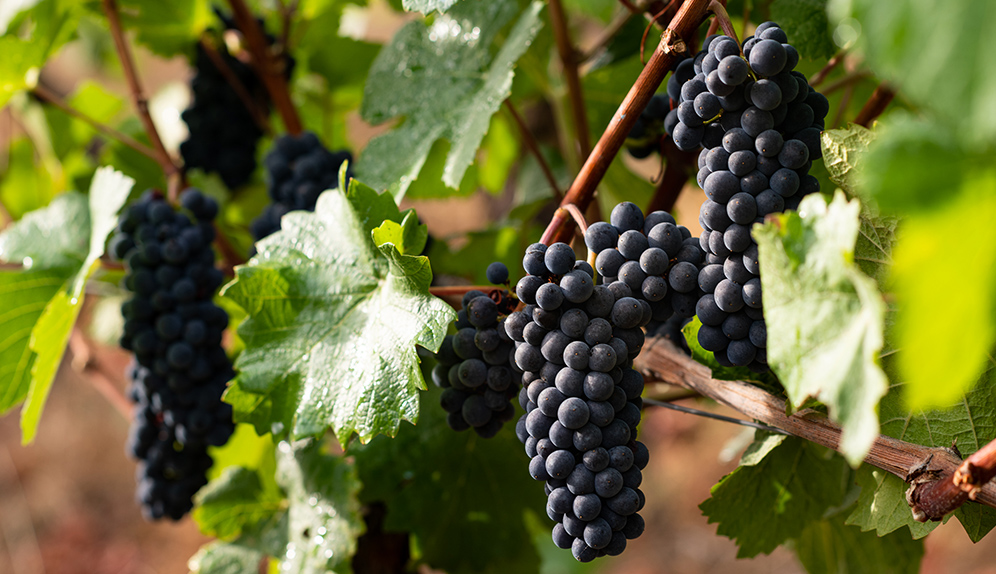
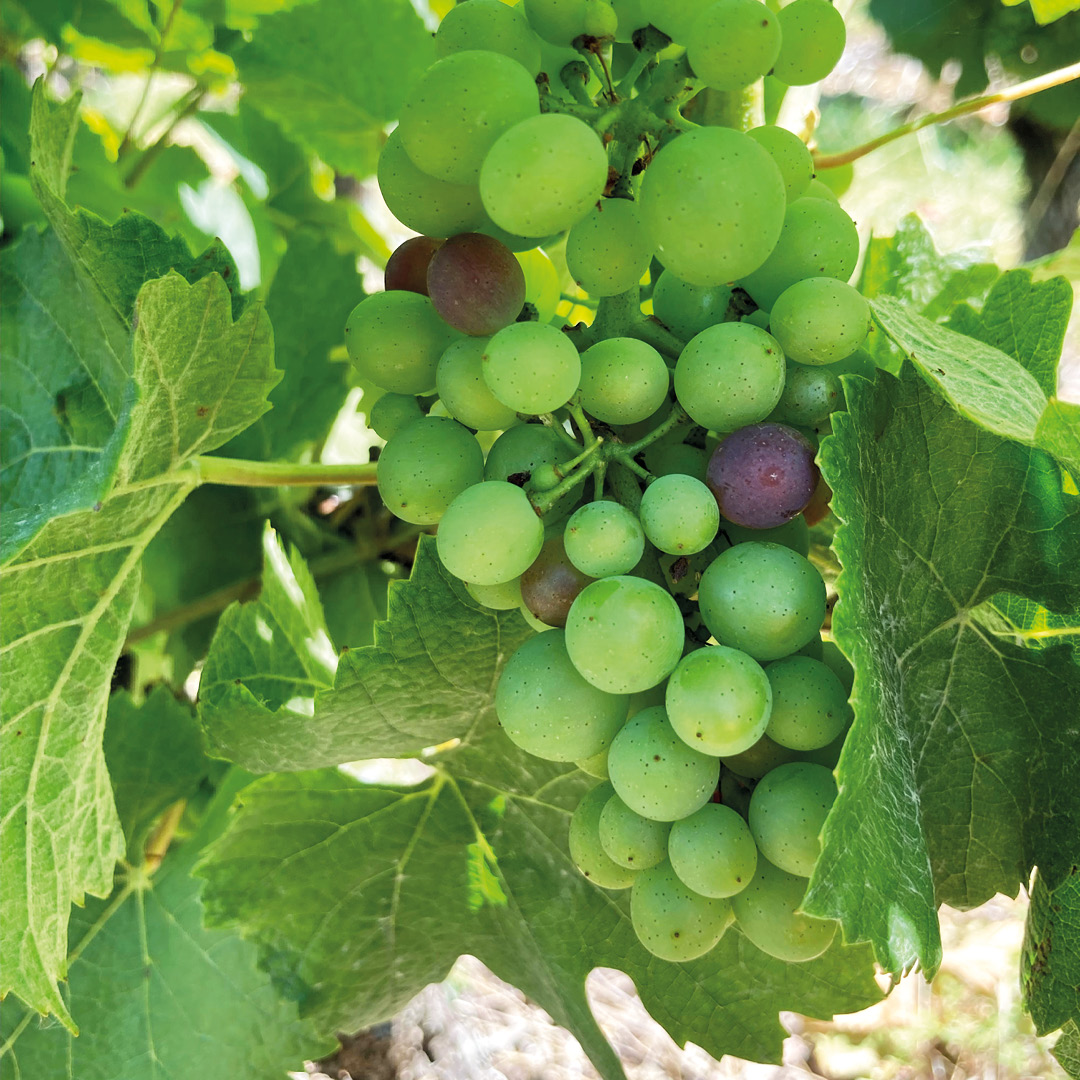
Pinot Noir is often considered the king of the region; in reality, this name encompasses a whole family of grape varieties of varying quality. The most renowned in the Côte d'Or is Pinot Noir Fin, commonly known as Noirien, which requires deep, well-drained, stony, clay-limestone soils. Yields are indeed low, but the main focus is on preserving the high quality of the vine, which is, in fact, quite delicate.

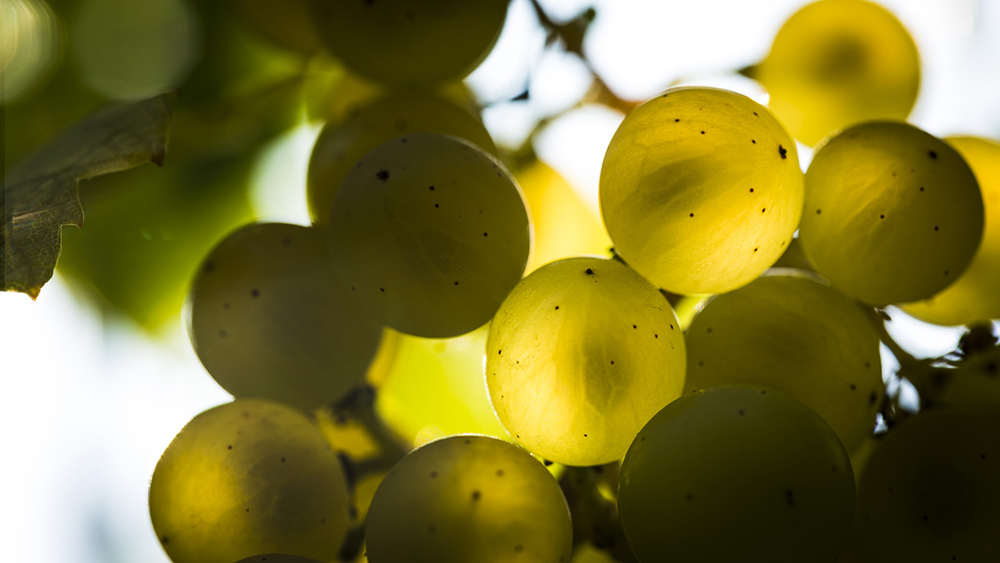
It is also accepted that Chardonnay gives the best of white wines; that is why it is often called “pinot blanc” or, paradoxically, “noirien blanc”; its small grapes with round and golden grains also give a rather rare wine.

While the owners of famous vineyards, primarily concerned with maintaining their reputation, adhere to these aristocratic vines, efforts are often made to obtain a higher yield without significantly compromising quality. Gamay grapes are therefore highly prized; they seem to originate from Burgundy, where they are said to have originated in the small hamlet of Gamay near Meursault; but they are widespread in all the neighboring regions, where they are highly valued. The winegrowers of Beaujolais or Bugey, who readily consider them superior varieties, are sometimes surprised by the low esteem in which they are held in the Côte-d'Or; a famous ordinance of Philip the Bold already prescribed the uprooting of the "bad and disloyal Gamay." In reality, while Gamay appears here as a second-rate variety compared to Pinot Noir, and while it thrives less well on stony slopes, it nonetheless produces an excellent, highly sought-after wine. Gamay is the grape variety used to plant many vines in the Arrière-Côte and Plaine regions. It is sometimes blended with Pinot Noir to make Passe-Tout-Grains, a wine with a well-established reputation. Finally, in Saône-et-Loire, Gamay is considered a top-quality grape variety.

Although there are white Gamays, it is generally Aligoté and Melon that represent for white wines the equivalent of Gamay for red wines.

All these plants had existed for a long time; for most of them, their history is intertwined with that of the vineyard; once mixed with many other plants, they were almost the only ones preserved during the reconstitution of the vineyard after the phylloxera crisis.

THE “CLIMATES”

“As much as the quality of the vine, wine depends on the soil and the exposure, on that combination which in Burgundy is called the climate. It is impossible to define a climate by the sum of its constituent elements; one can find soils with similar limestone or silica content, equally permeable to air and water, exposed to the sun's rays under the same conditions, and which, planted with the same vines, will produce different wines; and this is undoubtedly why it has never been possible to make Échézeaux or Pommard in the New World. One must take into account indefinable elements that are added to the whole; Mr. Gaston Roupnel astutely notes that this soil is the product of more than twenty centuries of work; the incessant tilling, which has turned over every plot of land, one after the other, has left nothing of the original soil; Pinot Noir now pushes its roots into soil lovingly gathered for him.

This is particularly true for the hillsides where the vineyards are located. Man, however, has only made such use of them because nature had already magnificently endowed them.

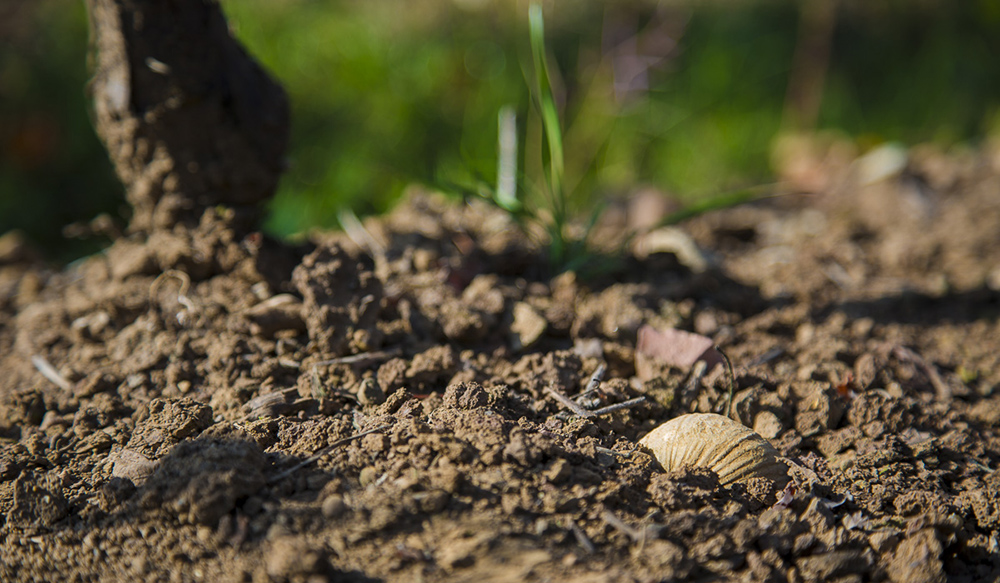
The limestones of the Côte belong to the various stages of the Middle Jurassic, Bajocian and especially Bathonian; the rock breaks into pebbles that mingle with reddish decomposed soils and the clays of the marly beds. One is struck by the diversity of these soils: nothing comparable to a homogeneous outcrop that would produce Burgundy wine, as other soils elsewhere yield superior qualities of cotton or coffee. The Bajocian slabs, the marls or hard limestones of the Bathonian, the gray limestones or whitish marls of the Oxfordian share the most renowned vineyards; one must certainly take great account of the mixture that allows the lower slopes to benefit from all the elements brought by runoff; the vines draw their sustenance from a soil whose composition cannot be explained solely by the subsoil.

The slope allows for easy drainage; the eastern exposure shelters the vines from westerly winds and provides morning sun that dissipates fog. By avoiding the vicinity of valleys, one escapes the cold air currents that descend from the mountain. Well exposed to the sun, the grapes ripen by the end of September or the beginning of October; the slender vines can scarcely wait longer; after the first few days of October, the harvest is rarely good; by the end of October, it is disastrous.
However, not all of the Côte is equally suitable for vines. The upper slopes, colder and less sheltered, are generally left to forests and wasteland; it is on the lower slopes, often even on the less steep embankment where these slopes end, that the best wines are found.

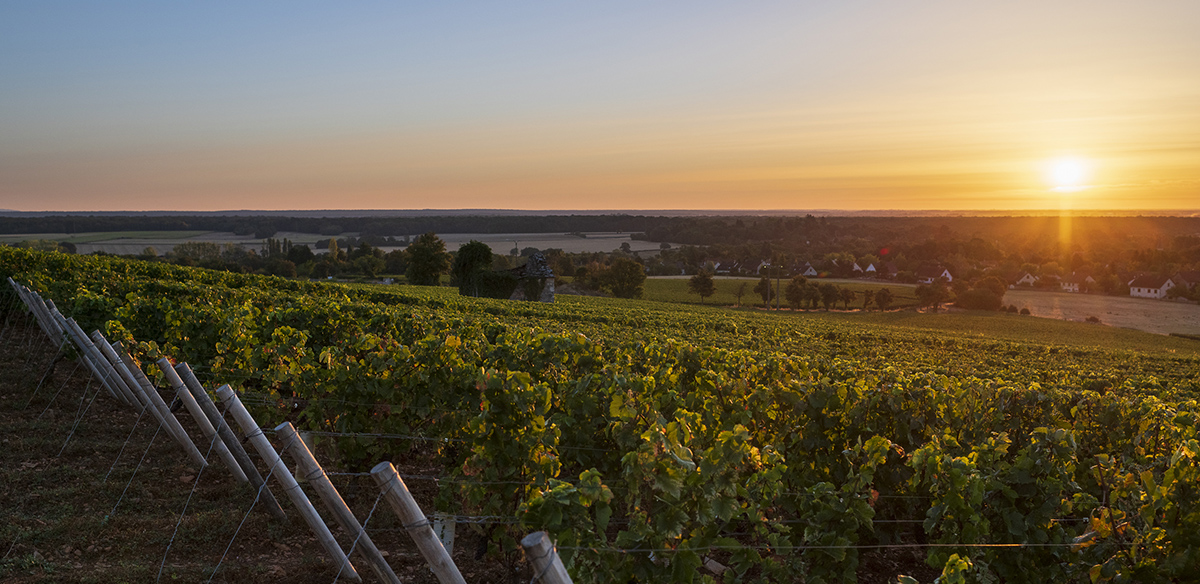
Climat Les Coères, Montagny 1er Cru

VINEYARD WORK

But the plant and the soil are nothing without the work of the farmer, and this is truer of the vine than of any other crop. It may seem tedious to list all the tasks to which winegrowers are subjected; it is necessary, however, if we want to show that there is hardly a season when they do not have to take to the vineyards, tool in hand.

No sooner is the previous harvest over, amidst the withered leaves, than the plowing begins again to prepare the soil. This soil must be constantly loosened and cleared of weeds: deep digging or plowing in the spring, successive scrapings with a hoe (a wide-bladed, short-handled pick), a two-pronged hoe, or a scraper. Often, at the bottom of steep slopes eroded by water, the soil is hauled up with a basket. Some of these tasks are now simplified; the small vineyard plow eases the winegrower's burden.

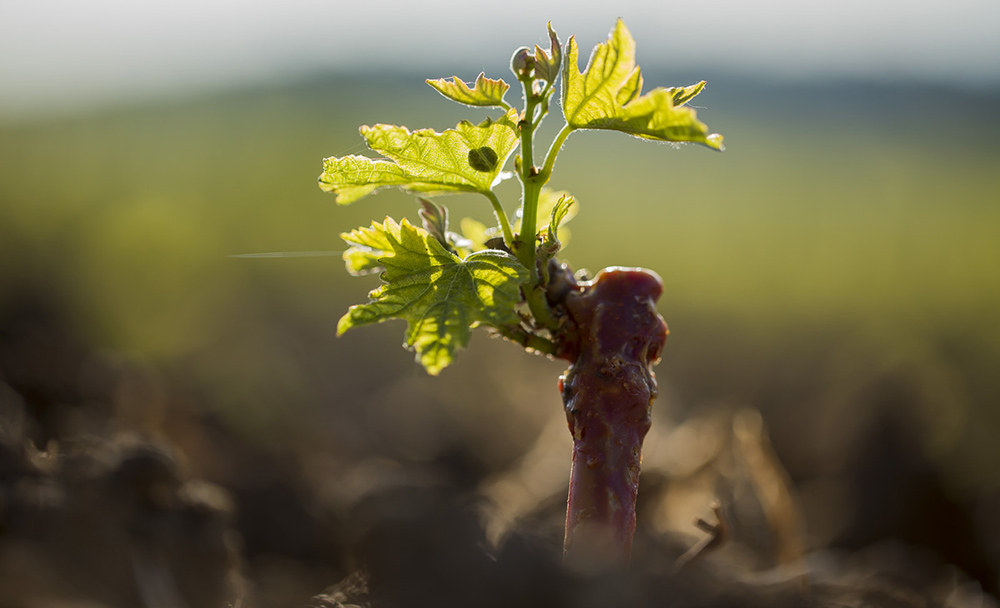
In this prepared soil, the vine must be constantly guided. As soon as the first rays of a still pale sun announce spring, the vine is pruned to remove dead wood and prepare for the next growth. Pruning is either short, leaving only two or three buds (eyes) on each shoot, or long, depending on the vigor of the vine. Moreover, pruning methods are extremely varied; each winegrower has their preferences and adapts them according to the soil, the vines, and the desired result. Pinot Noir vines are generally pruned in a "goblet" shape, with arms more or less widely spaced; but often a mixed pruning method is also used, with shoots of unequal lengths.

In the past, when pruning Pinot Noir vines, only one cane, the tallest, was kept; the vines thus grew longer year after year, reaching up to 1.5 meters, and the older vines were considered to produce the best wines. This system led to the premature aging of the vine, which then had to be rejuvenated by layering; it has been completely abandoned since the phylloxera epidemic.

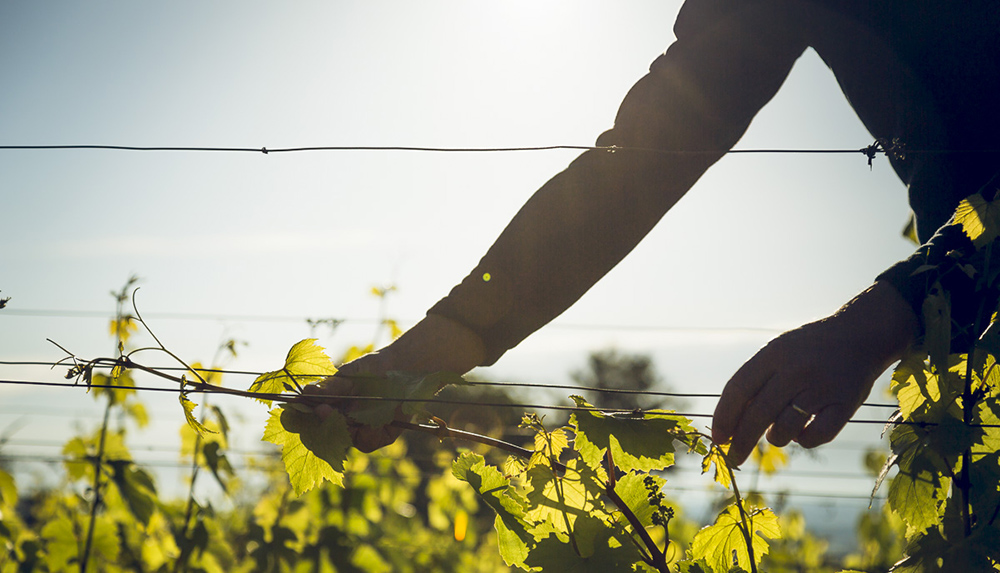
Spring was also the time when the stakes (the paiseaux) were replanted, having been removed before winter; today, in most vineyards, each row of vines is trained along taut wires, eliminating the need for this care. The branches must be carefully tied to these stakes or wires as they grow, secured with willow twigs, rye straw, or, nowadays, rushes. But the vine, if too vigorous, risks growing entirely covered in leaves if it is not pruned from time to time, if all the unwanted buds are not removed by a process of trimming.

All this work has always been necessary for anyone wanting to bring grapes to the earth, and these were hardships willingly endured. People are less resigned to the new vexations brought about by vine diseases. Downy mildew, favored by damp weather, must be combated with sprays of copper-based solutions. A daunting and dangerous task, where clothing and face become saturated with a bluish, poisonous liquid, while the man, with the heavy tank on his back, pumps tirelessly and directs the spray alternately to the right and left. It is true that today the rows of vines are often more spaced out: a mule carries the sprayer from which the jets of copper sulfate gush forth; but this does not prevent the man from preparing, handling, and directing the spray, immersed in this noxious atmosphere. And the operation must be repeated three or four times, or even more. Against powdery mildew, which is especially troublesome after mild winters, one must sprinkle with sulfur as often as needed; treatments with arsenates and nicotine against insects, particularly the grape berry moth, should also be added. How fortunate the winegrowers would be, if all these remedies were sufficient! But one can never be entirely certain of having applied them at the right time.

The last task is the grape harvest. In the past, it only began on a date set by the local authority; the official harvest proclamation also specified the date from which gleaning was permitted to the poor. The diversity of grape varieties today no longer allows for such rigid rules; everyone harvests as they see fit; but this is not always without drawbacks, and there are sometimes calls for the reinstatement of the official harvest proclamation.
This grape harvest has been celebrated enough by poets that there is no need to commemorate its symbolism, to describe the precise and moving act of picking, or to recount the boisterous joys that accompany it. We are less aware of the labor it represents. There is only joy in picking the golden bunches in the autumn sun; but we must also mention the long periods spent crouching in the sticky mud, the misty mornings when leaves glistening with dew wet arms up to the shoulders, the hunt for grapes that fingers numb with cold pursue between clods of earth, the heavy baskets that women lift with difficulty, while they drag themselves along, stumbling, misshapen shoes caked in mud. And the feverish haste of threatening days when rain threatens to interrupt the entire harvest! And the years of desolation where one picks here and there a few scattered bunches while thinking of all the labors that will not have obtained their reward!
WINE

The grapes destined for white wine go directly to the press; red wines require a long fermentation in vats, a carefully monitored process during which the grape juice gradually transforms into wine. For fine wines, the grapes are carefully destemmed beforehand to avoid an excessively high tannin content. After six to eight days, fermentation is complete, the grapes are crushed one last time, the extracted wine is drawn off through the opening at the bottom of the vat, and the bunches are taken to the press to extract the last drops. In the past, these were often imposing presses with a large wooden or stone base; channels crisscrossed and converged, carrying the wine to the large gargoyle on the side. To press down the weight of the grapes, a whole scaffold of planks was stacked around the central screw, all the way down to the enormous bolt which descended, driven by a system of levers and wedges. There were also more modest presses, made of wood, sometimes on wheels, with horizontal screws; these still exist, but alongside them are cast-iron presses; often also mounted on wheels and moved from house to house. Finally, in modern installations, hydraulic presses are now frequently used.

No sooner is the wine stored than thoughts turn to the residues of pressing; this compact mass of compressed and emptied grapes, so hard that it must be hacked open with an axe, will, once distilled, yield marc brandy. Aged in wooden barrels, it will become the famous Marc de Bourgogne. The distillation debris itself, a blackish dust with a heady odor, can be set aside to be used as fertilizer.
And little by little, the wine's qualities become clearer; the small silver cup, the tastevin, in which a sip of the liquid is taken, allows for an increasingly confident judgment; on the day of the Hospices de Beaune wine auction, in mid-November, the jury can already announce its verdict to the assembled crowd of connoisseurs. The vintage then takes on a meaning, the date becomes a title; it is its value that will be precisely evoked by the figures whispered by the head waiters at banquets in both worlds, for fifteen or twenty years. Years that were too wet, years that were too dry, years of spring frosts or, on the contrary, glorious years that judiciously distributed the spring moisture and the August sun to the grapes. It is impossible to convey with circumlocutions what a wine that is too dry, or too brittle, is, to define the "body", the "mellowness", the "velvety", the "rising", the "bouquet" of great wines, all the qualities laboriously evoked on the menus of Parisian restaurants.

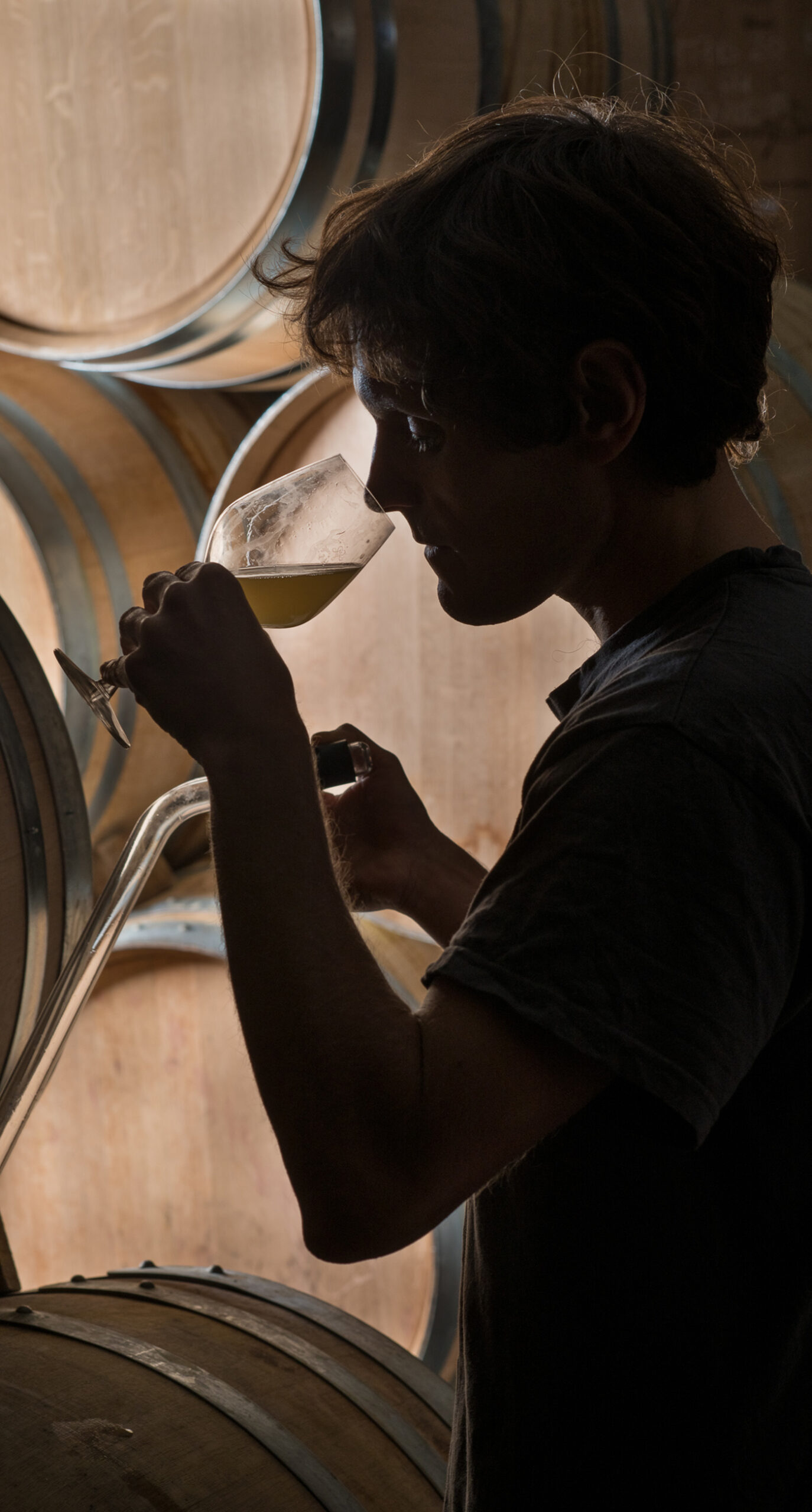
Even better than in the tastevin, it is in the tasting glass, wide and bulbous at the base, that these various qualities are analyzed: warmed under the palm of the hand, it concentrates the aroma and allows one to slowly prepare for the tasting. But once the wine is in the barrels, the winemaker is far from having to think only of the next harvest.

Several times more, the stream in front of the house will carry reddish water mixed with lees and scum; the winemaker will wash his barrels, scraping the inner wall with the long chain which moves from right to left with a loud clanging of metal; he will thus be able to change the wine from barrel to barrel to decant and aerate it; he will carry out this racking once or twice a year; he will fine it several times by introducing gelatin or egg whites; and, after two years in the barrel, the wine will be ready to be bottled.

Pierre Poupon et Pierre Forgeot, Les Vins de Bourgogne, 1952

THE MERCUREY REGION

This region should be linked to the Côte-d’Or and more specifically to the Côte de Beaune, of which it is a natural extension. Indeed, the soil, the methods of cultivation and winemaking, and the commercial traditions are similar.

Suzanne Blanchet, Les vins de Bourgogne, 1985

“The Côte Chalonnaise is named in reference to Chalon-sur-Saône, which is only a few kilometers from the first vineyards.

During the Gallo-Roman period, wine production was intense. River transport flourished, and wines from Occitania were shipped upriver to the capital via the Rhône and Saône rivers. Excavations in the port have unearthed numerous fragments of amphorae. Givry wine was highly prized in the Middle Ages, and Charles VII was already enjoying it in 1390. Henry IV made it his regular drink and even exempted it from import duties in Paris. These duties were soon reinstated, however, as more wine was being imported than Givry could produce.

In 1776, Courtépée said of Givry: “This country is the Volnay of the Chalonnais.”

The fact that it was not included in the Côte d'Or in 1791 greatly damaged the reputation of Chalonnais wines. Yet in 1816, wines from the Côte Chalonnaise and Mercurey were being sold under the name Côte de Beaune.

THE TERROIRS

The Côte Chalonnaise comprises five major appellations, while the remaining communes are entitled to the Bourgogne appellation: the red wines of Mercurey, Rully, and Givry, and the white wines of Bouzeron, Rully, and Montagny. It is composed of Triassic and Jurassic soils. All the terroirs therefore have a limestone or clay-limestone substrate, sometimes clay-dolomitic, mostly similar to that of the Côte-d'Or.

THE GRAPE VARIETIES

Pinot Noir is the sole grape variety used for the production of red wines in the Chalon region. Chardonnay and Aligoté are used to produce white wines.

MONTAGNY

Vineyard of 301 hectares, including 207 in Premier Cru, exclusively in white wines (Chardonnay).

The southernmost of the Côte Chalonnaise vineyards, established in 1936. The production area includes the four villages of Montagny-lès-Buxy, Buxy, Saint-Vallerin, and Jully-lès-Buxy. The monks of Cluny sourced their white wine from these Kimmeridgian villages.

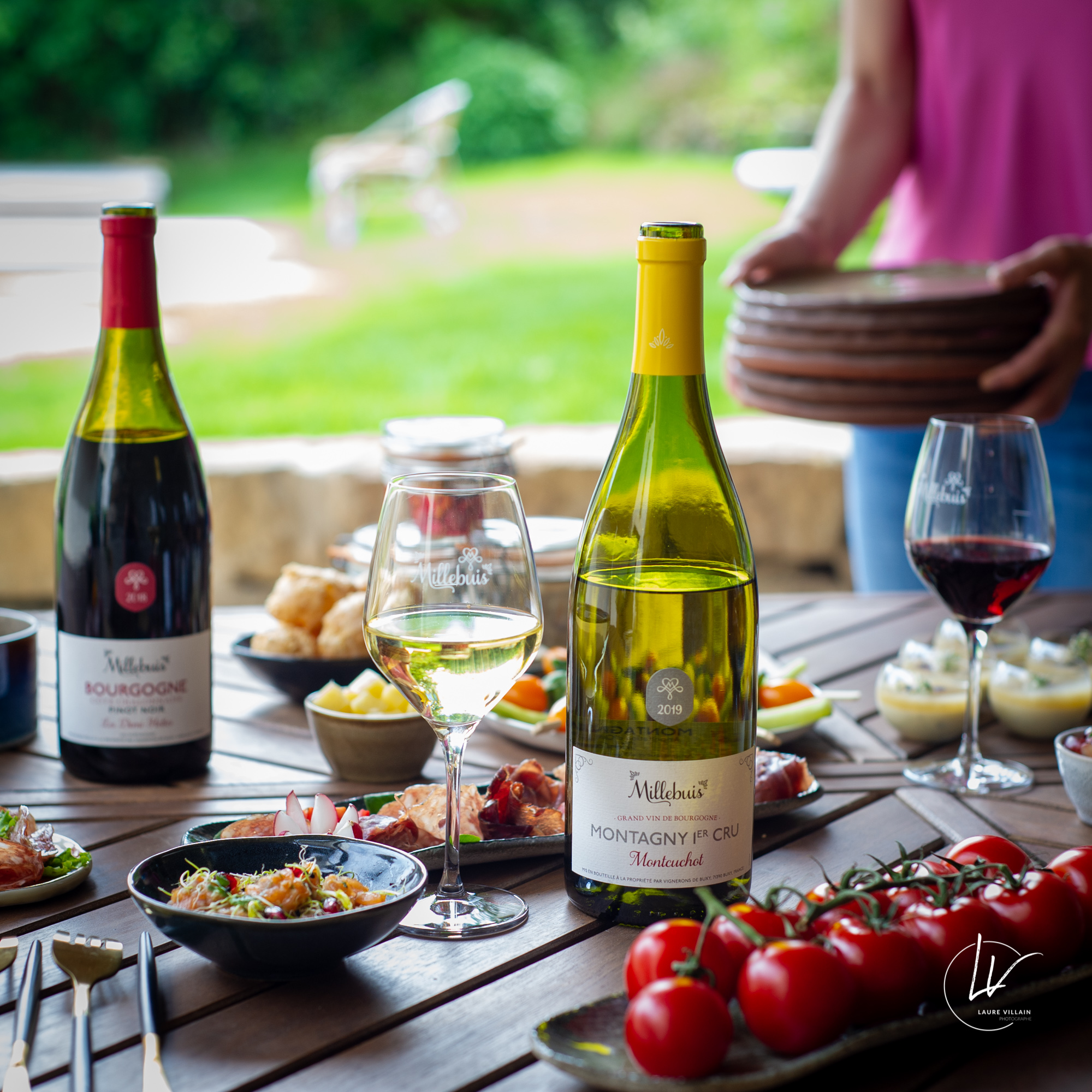
The "Montagny" appellation includes 51 Premier Cru classified vineyards, more than 30 of which are in the single commune of Montagny-lès-Buxy! The best known are Montcuchot, Les Coères and Les Chaniots (or Chagnots).

Appreciation : A white wine that "keeps the mouth fresh and the head clear", likely an evolution of a local proverb: "Fresh breath and clear ideas"!

An excellent white wine that was formerly called “Côte de Buxy”, named after this town which has always shown independence. Facing east-southeast, the slopes reach 400 m in altitude.

“Its aromas of lemongrass and white hawthorn, its taste of bitter almond and honey, its richness and sometimes its texture mark it for the attention of enthusiasts as a rare and little-known white wine, worth seeking out.”

Curiosités : the fortifications of Buxy, the beautiful stone of Buxy…

GIVRY

Vineyard of 265 hectares: 220 hectares in red wines (Pinot noir) and 45 hectares in white wines (Chardonnay).

It is situated on slopes with a limestone subsoil, on clay-limestone soils and facing south/southeast. It extends across the 3 communes of Givry (and its hamlets of Poncey, Cortiambles and Russilly), Jambles and Dracy-le-Fort.

Legend has it that King Henry IV made it his favorite wine… Whether a well-founded legend or an age-old marketing ploy, Givry demonstrates its commercial acumen, and it is true that its Pinot Noir will better accompany a chicken in a pot than a sweet white wine!

The best-known first vintages are: Clos Jus, La Baraude, Servoisine, Grand Marole, Clos Salomon, Le Vernoy, Cras Long, Cellier aux Moines, Les Bois Chevaux, Clos Saint-Pierre, Clos Saint-Paul, Clos Charlé, Petit Marole, Clos Marceau

Vines: With the exception of Bois Chevaux, which is steeply sloping and reaches an altitude of 325 m, they are located between 240 m and 280 m, facing east-southeast or south.

Floors: Oxfordian limestones and marly limestones

Wines: Fine and supple white wines. Deeply colored, lively, vibrant, and full-bodied red wines with a delicately nuanced bouquet. Blackberry and violet, clove, beneath a robe that can reach deep mauve hues.

“This country, adorned with a rich hillside, is the Volnai of the Châlons region.” This is how Abbot Claude Courtépée expressed himself in 1776.

Points of interest to see: city ​​center XVIIIth century, the round market hall, the mill of the monks' cellar, the Cortiambles church, the Maison Dieu…

MERCUREY

Vineyard of 650 hectares: 575 hectares in red wines (Pinot noir) and 75 hectares in white wines (Chardonnay).

Spread across the two communes of Mercurey and Saint-Martin-sous-Montaigu, Mercurey is undoubtedly the most famous of the Côte Chalonnaise wines. The village enjoys a sunny southern exposure, perched on a slope at the foot of a limestone escarpment overlooking a transverse break in the coastline…

The best-known Premier Cru vineyards are: Le Clos du Roy, Le Clos des Grands Voyens, Clos Marcilly, Clos de Paradis, Clos des Montaigus, Les Fourneaux, La Cailloute, Clos des Barraults, Le Clos l’Évêque, Les Champs Martin, Les Combins, Les Croichots…

“Do you know what a caress is? Drink a glass of Mercurey!” – Colette

Appreciation : It has body, bouquet, finesse and a distinction that makes it very similar to certain wines from the Côte de Beaune.

Vines: Located between 230 m and 320 m altitude, the best between 250 m and 280 m, facing east to south.

Floors: Oxfordian marls and marly limestones

Wines: Full-bodied red wines, beautiful ruby ​​color, distinction and finesse, delicious bouquet.

Mercurey, like all its neighboring villages, suffered many disasters. Highly prized in its time, Mercurey wines enjoyed immense popularity. The village, built on the site of an ancient temple erected in honor of Mercury, took its name from him. A center for great red wines, Mercurey wines are appreciated by connoisseurs for both their lightness and their... équilibre and their fragrance. They also age well. In this vineyard, some white wines of rare finesse are produced, elegant and distinguished with a refined taste of violet and hawthorn.

RULLY

Vineyard of 344 hectares: 226 hectares in white wines (Chardonnay) and 118 hectares in red wines (Pinot noir).

Renowned white wines, lesser-known but surprising reds. The appellation is located in the communes of Rully and Chagny. The vineyard is bean-shaped. Situated between 230 and 300 meters above sea level, the vineyard offers brown or calcareous soils with a slightly clayey texture (the soils of Pinot Noir) and clay-limestone soils (those of Chardonnay).

The best-known Premier Cru vineyards are: Agneux, Margotés, Clos du Chaigne, Clos Saint-Jacques, En Grésigny, Vauvry, Mont-Palais, Le Meix Cadot, Les Pierres, La Bressande, Champ Cloux, La Pucelle, La Renarde, Pillot, Cloux, Raclot, Rabourcé, Écloseaux, Marissou, La Fosse, Chapitre, Pillot, Molesme, Préaux.

Appreciation : A very distinctive and fine white wine, dry. Remarkably sparkling. It was the origin of the significant trade in sparkling Burgundy wines that exists in this small village.

Points of interest to see: Village typiquement bourguignon, château du XIVth and XVth century.

In bygone days, Rully was the darling of wine lovers. Then, in turn, Rully experienced both glory and despair. A thousand reasons, history first and foremost, then the devastating phylloxera epidemic. Resurrected from all these trials, Rully proudly holds its head high. Specializing in white wines, the winemakers are very proud to offer true connoisseurs and gourmets delicate wines with a fragrant bouquet that captures all the flowers of spring, a brilliant color, and a subtle flinty taste.

BOUZERON

Vineyard of 51 hectares producing white wines (Aligoté).

Approximately 18 kilometers northwest of Chalon-sur-Saône and about 2 kilometers west of Chagny. Bouzeron is a white wine with a protected designation of origin produced in the two communes of Bouzeron and Chassey-le-Camp, in Saône-et-Loire.

Floors: Marno-calcaires oxfordiens.

Points of interest to see: typical wine-growing village nestled in a valley, interesting church.

Like many other vineyards, the Bouzeron vineyard was developed by the monks of Cluny Abbey. The Aligoté grape variety thrives in these soils, and in 1730, Courtépée praised Bouzeron's Aligoté wine in his study of the Duchy of Burgundy. Julien wrote in his 1832 topography of famous wines, "the white wines of Bouzeron have a very particular taste reminiscent of the third vintage of Meursault."

Old vines of interesting selections (the so-called golden Aligoté with thick skin — hence the need for complete ripening — as opposed to the green Aligoté, which is more productive but sometimes ripens with difficulty).

“Renowned white wines, fine bouquet,” noted Victor Vermorel and René Danguy in 1894 regarding the white wines, which were then as important as the reds. These were Gamay Blancs (Melons) and Giboudot Blancs (Aligoté).

In 1998, the Bouzeron communal appellation was created for the Aligoté grape variety only, in the communes of Bouzeron and Chassey-le-Camp (a major prehistoric site: the Chasséen civilization). Initially, there were no Premier Cru wines.

BIBLIOGRAPHIE SOMMAIRE

• Georges Chabot, La Bourgogne, Éditions Armand Colin, Paris, 1945
• Pierre Poupon et Pierre Forgeot, Les Vins de Bourgogne, Presse Universitaires de France, Paris, 1952
• Suzanne Blanchet, Les vins de Bourgogne, Éditions Jema, 1985
• Roger Dion, History of vines and wine in France / from their origins to the XIXth century, 1959
• Jean-François Bazin, Le vin de Bourgogne, Dunod, 2013

Find us on Instagram  and Facebook